
Why Supply Chain Visibility Is Not a One-Time Exercise
By Paul R Salmon FCILT, FSCM
Introduction: Your Supply Chain Map May Already Be Wrong
Organisations are investing enormous amounts of time and money trying to understand their supply chains.
They identify suppliers.
They map dependencies.
They analyse lead times.
They assess financial health.
They identify manufacturing locations.
They investigate Tier 2, Tier 3 and deeper-tier relationships.
They build dashboards, digital twins, control towers and supplier-risk models.
But there is a fundamental problem.
The moment that information is collected, it starts to age.
A supplier changes ownership.
A manufacturing line moves.
A sub-tier supplier changes.
A lead time increases.
A raw-material source changes.
A company becomes financially distressed.
A production facility closes.
A new geopolitical dependency emerges.
A component becomes obsolete.
A supplier quietly outsources production to another country.
Yet the organisation’s supply-chain system may continue to show exactly what it showed six months ago.
The question, therefore, should not simply be:
“Do we understand our supply chain?”
It should be:
“How long does what we know about our supply chain remain true?”
This article proposes a concept for thinking about that problem:
The Supply Chain Half-Life.
What Is Supply Chain Half-Life?
The idea is borrowed from the concept of half-life used in other disciplines.
Applied to supply chains, it represents the period over which a meaningful proportion of what an organisation knows about its supply chain becomes outdated, inaccurate or no longer sufficiently reliable for decision-making.
Imagine an organisation conducts a major supply-chain illumination exercise today.
It establishes:
- supplier identities;
- manufacturing locations;
- sub-tier relationships;
- lead times;
- ownership structures;
- alternative sources;
- production capacity;
- country dependencies;
- raw-material dependencies;
- transport routes;
- financial health;
- geopolitical exposure.
At that moment, the organisation might have an extremely accurate picture.
Call it 100% confidence.
But what happens next?
Three months later, some information has changed.
Six months later, more has changed.
Twelve months later, significant parts of the original assessment may no longer reflect reality.
The organisation still possesses the data.
But possession of data is not the same as possession of truth.
That distinction matters.
Data Has a Shelf Life
Supply-chain organisations often treat master data as if it were permanent.
It isn’t.
Different types of supply-chain information decay at different speeds.
An NSN, SKU or product identifier may remain stable for years.
A supplier’s registered address might remain stable for decades.
But other information can change extremely quickly.
Supplier financial health can deteriorate in weeks.
Lead times can change in days.
Manufacturing capacity can change following the loss of a machine, workforce or raw-material source.
Ownership can change overnight.
Transportation routes can change because of conflict, sanctions, weather or infrastructure disruption.
Sub-tier relationships can change without the customer ever being informed.
Therefore, there is unlikely to be a single Supply Chain Half-Life.
There are potentially multiple half-lives within the same supply chain.
The Supply Chain Half-Life Model
Consider supply-chain knowledge across six broad areas.
1. Supplier Identity Half-Life
How frequently do suppliers, subcontractors and sub-tier relationships change?
The Tier 1 supplier may remain the same while everything underneath it changes.
This is particularly important where organisations believe that understanding their prime contractor equates to understanding their supply chain.
It does not.
2. Geographic Half-Life
How frequently does the physical location of production change?
The contractual supplier might be headquartered in the UK while production takes place elsewhere.
Production may subsequently migrate again.
Without regular refresh, an organisation may believe it has a domestic supply chain when critical manufacturing processes have gradually moved offshore.
3. Lead-Time Half-Life
How long does a recorded lead time remain representative of reality?
A contractual lead time of 90 days might gradually become an actual lead time of:
120 days.
Then 180.
Then 270.
Yet planning systems may continue operating using the original assumption.
This creates a particularly dangerous form of supply-chain risk:
the organisation’s planning model remains mathematically correct while its assumptions have become wrong.
4. Capacity Half-Life
Supplier capacity may be one of the least understood variables in supply-chain management.
A supplier capable of producing 1,000 units today may not be capable of producing 1,000 units next year.
Machinery ages.
Workforces change.
Skills disappear.
Other customers consume capacity.
Production lines close.
Raw materials become constrained.
This matters enormously when organisations assume that industry can simply “surge” production during a crisis.
Capacity data therefore needs its own half-life.
5. Ownership Half-Life
Who ultimately owns the companies within the supply chain?
This question is increasingly important.
Corporate acquisitions, mergers, investment funds and international ownership structures can fundamentally alter the risk profile of a supplier.
A company considered low-risk when assessed may subsequently be acquired by another organisation.
Yet unless ownership data is continuously refreshed, the original assessment remains unchanged.
6. Risk Half-Life
Perhaps the fastest-changing category is risk itself.
Political instability.
Sanctions.
Conflict.
Cyberattack.
Natural disasters.
Trade restrictions.
Financial distress.
Energy shortages.
Regulatory change.
A supplier assessed as low-risk six months ago may now sit at the centre of a major geopolitical vulnerability.
Risk assessments therefore cannot be treated as static documents.
They are perishable information.
From Data Quality to Data Freshness
Most organisations already talk about data quality.
Is the information:
accurate?
complete?
consistent?
valid?
But another dimension deserves far greater attention:
Freshness.
A data field can be perfectly complete and completely wrong.
Consider:
Supplier: ABC Components
Manufacturing country: United Kingdom
Lead time: 90 days
Alternative source: Yes
Risk: Low
Every field is populated.
The system might therefore report excellent data completeness.
But what if:
production moved overseas eight months ago;
actual lead time is now 240 days;
the alternative supplier stopped producing the item;
and the remaining manufacturing site sits within a high-risk geographic region?
The database is complete.
But the decision-maker is being given a false picture.
Completeness without currency can create false confidence.
The Defence Dimension
This issue becomes particularly important in Defence.
Defence equipment often remains in service for decades.
During that time, the industrial ecosystem supporting it can change dramatically.
Original equipment manufacturers change ownership.
Production lines close.
Specialist skills disappear.
Components become obsolete.
Sub-tier suppliers consolidate.
Raw-material sources migrate.
Manufacturing moves internationally.
Tooling is disposed of.
Alternative suppliers disappear.
Yet Defence may continue to hold historic supplier information against the item.
That creates a potentially dangerous disconnect between:
the supply chain Defence believes it has
and
the supply chain that actually exists.
In peacetime, that difference may remain hidden.
During mobilisation or conflict, it becomes critical.
The Dangerous Question: “Who Is Our Supplier?”
For many organisations, supply-chain visibility still begins and ends with the Tier 1 supplier.
But knowing who sends the invoice is not the same as knowing who makes the product.
A simple component might depend upon:
a Tier 1 distributor;
a Tier 2 manufacturer;
a Tier 3 specialist processor;
a Tier 4 raw-material producer;
a specialist machine;
a particular geographical cluster;
and a transport route through a strategically vulnerable region.
Each relationship has its own half-life.
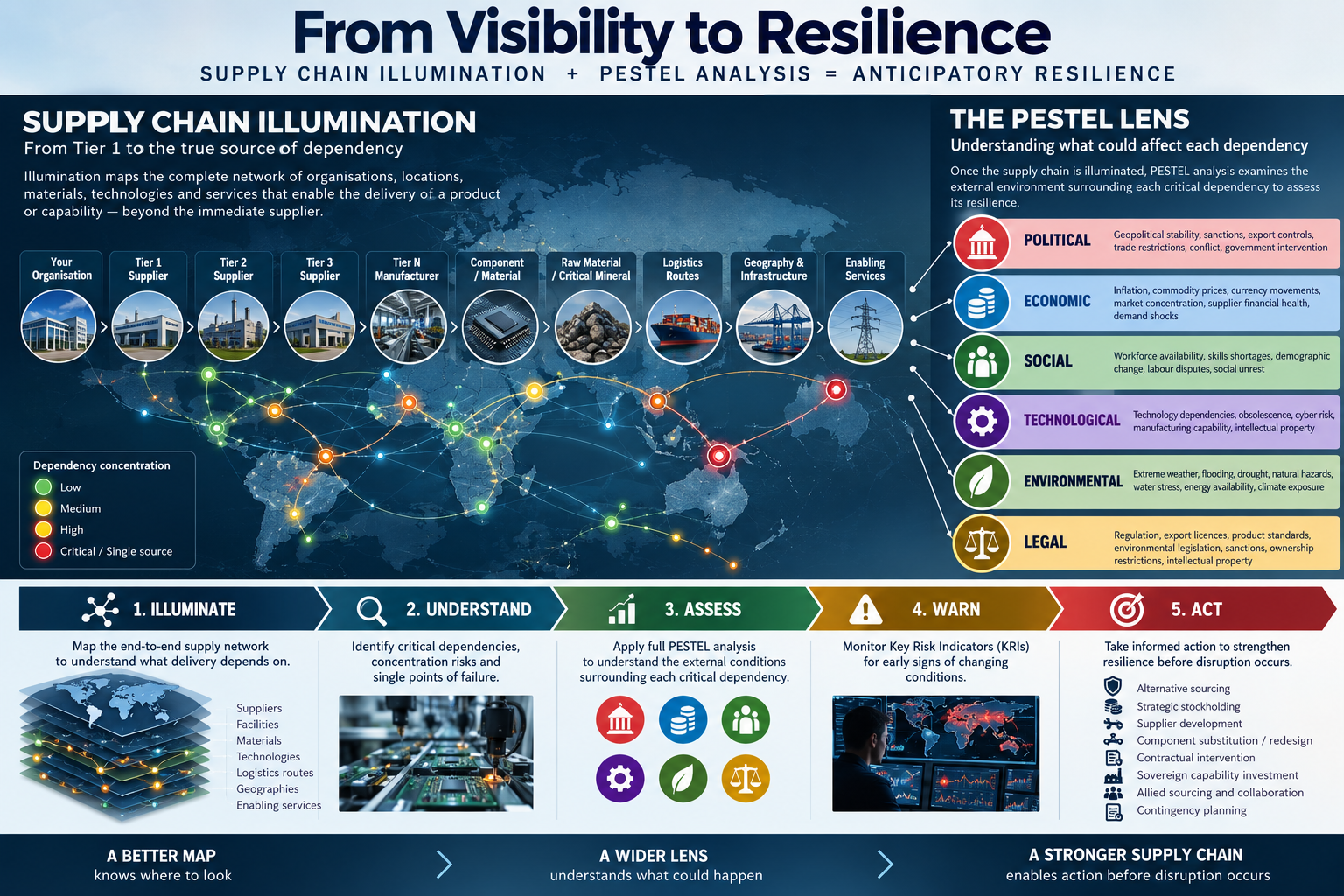
Therefore, supply-chain illumination cannot be treated as a project that is completed.
It must become a continuously refreshed capability.
From Supply Chain Mapping to Supply Chain Monitoring
This changes the philosophy of supply-chain visibility.
Traditional approach:
Map → Analyse → Report → Finish
A resilient approach should be:
Discover → Validate → Monitor → Refresh → Reassess → Act
Supply-chain illumination becomes a cycle rather than a project.
The objective is no longer simply to create visibility.
It is to maintain visibility.
That distinction is fundamental.
Measuring Supply Chain Half-Life
Organisations could begin by recording the date on which critical supply-chain information was last independently verified.
For every critical item or supplier, leaders could ask:
When was the supplier last verified?
When was manufacturing location last confirmed?
When was production capacity last assessed?
When was ownership last checked?
When was lead time last recalculated from actual performance?
When were sub-tier suppliers last illuminated?
When was geopolitical exposure last reassessed?
This creates a new type of Key Risk Indicator:
Supply Chain Data Age.
Rather than merely asking whether information exists, organisations can ask how old it is.
For example:
| Information | Last Verified | Maximum Age | Status |
| Tier 1 Supplier | 2 months | 12 months | Current |
| Manufacturing Site | 14 months | 6 months | Review |
| Lead Time | 1 month | 3 months | Current |
| Tier 2 Supplier | 19 months | 12 months | Review |
| Capacity | 26 months | 6 months | Critical |
| Ownership | 8 months | 6 months | Review |
Suddenly the organisation can see something that traditional data-quality dashboards cannot show:
where its knowledge is becoming stale.
Not Everything Needs the Same Refresh Rate
A common objection will be cost.
Surely organisations cannot continuously reassess millions of items and thousands of suppliers?
They should not.
The refresh rate should be risk-based.
A low-value, readily available commercial item with dozens of suppliers may require little monitoring.
A mission-critical component with:
- one supplier;
- long replenishment lead time;
- overseas manufacture;
- no substitute;
- specialist raw materials;
- high operational consequence;
- and limited stock
should be treated very differently.
This suggests that Supply Chain Half-Life should be linked to criticality.
The more critical the item and the more fragile its supply chain, the shorter the acceptable age of the information.
A New KRI: Supply Chain Knowledge at Risk
This could ultimately create a powerful senior-level measure:
Percentage of Critical Supply Chains Within Their Defined Half-Life.
For example:
92% – healthy.
78% – increasing uncertainty.
61% – significant visibility degradation.
43% – major decision-making risk.
This would provide leaders with something they rarely have today:
a measure of how much of their supply-chain picture they can still trust.
Importantly, this is not another measure of supplier performance.
It is a measure of the organisation’s knowledge of its own supply chain.
The Product Passport Opportunity
The emergence of Digital Product Passports creates an important opportunity.
Rather than seeing product passports simply as another regulatory data requirement, organisations should recognise their potential to improve the currency of supply-chain information.
If product-level information can progressively provide structured data on:
origin;
materials;
manufacturer;
component composition;
environmental characteristics;
and potentially wider supply-chain relationships,
then product passports could become part of a much broader supply-chain illumination architecture.
For Defence, this is particularly important.
The question should not be:
“Can Defence obtain an exemption?”
It should be:
“How can Defence exploit this emerging data ecosystem to understand its supply chains better than it does today?”
Artificial Intelligence Changes the Equation
Historically, continuously monitoring thousands of suppliers would have required enormous human effort.
That is changing.
AI, graph analytics, corporate ownership databases, financial intelligence, shipping data, trade data, news monitoring and product-level information increasingly allow supply-chain changes to be identified automatically.
Instead of periodically asking:
“Has anything changed?”
systems can increasingly identify:
“Something has changed – investigate it.”
That turns supply-chain assurance from periodic inspection into continuous sensing.
The Leadership Question
Every senior supply-chain leader should therefore ask:
“How old is the information on which I am making this decision?”
Because a sophisticated dashboard built upon stale information is still a poor decision-support system.
A beautifully visualised wrong answer remains a wrong answer.
This is particularly important as organisations increasingly deploy AI.
AI does not remove the problem of stale supply-chain information.
It potentially amplifies it.
If an AI model consumes outdated supplier, lead-time, capacity or dependency data, it can produce highly convincing recommendations based upon a supply chain that no longer exists.
From Visibility to Confidence
The ultimate objective should therefore not be “100% supply-chain visibility.”
That is probably unrealistic.
Instead, organisations should seek something more meaningful:
Supply Chain Confidence.
For each critical supply chain, leaders should understand:
What do we know?
When did we verify it?
How quickly could it change?
What do we not know?
What happens if our assumptions are wrong?
That is a much stronger foundation for resilience.
Conclusion: Supply Chains Change Faster Than Our Systems
Supply-chain visibility is often discussed as though it were a destination.
It is not.
It is a continuously depreciating asset.
Every supplier map, dependency analysis, lead-time assumption and risk assessment begins ageing the moment it is completed.
The strategic challenge is therefore not simply discovering the supply chain.
It is ensuring that our understanding of it does not decay faster than our ability to refresh it.
The organisations that recognise this will move beyond static supply-chain maps towards continuously refreshed networks of intelligence.
Those that do not may discover something uncomfortable when the next disruption arrives:
they had excellent visibility.
Unfortunately, it was visibility of yesterday’s supply chain.
Final Thought
You cannot manage the supply chain you cannot see. But seeing it once is not the same as knowing it now.
Paul R Salmon FCILT, FSCM
Any views expressed are my own and are not those of UK Defence.



Leave a Reply