
By Paul R Salmon FCILT, FSCM
To the customer, an order can look beautifully simple.
They visit a website, choose a product, click “buy”, receive an order confirmation, and wait for the parcel to arrive. A few days later, the doorbell rings. The package is there. Job done.
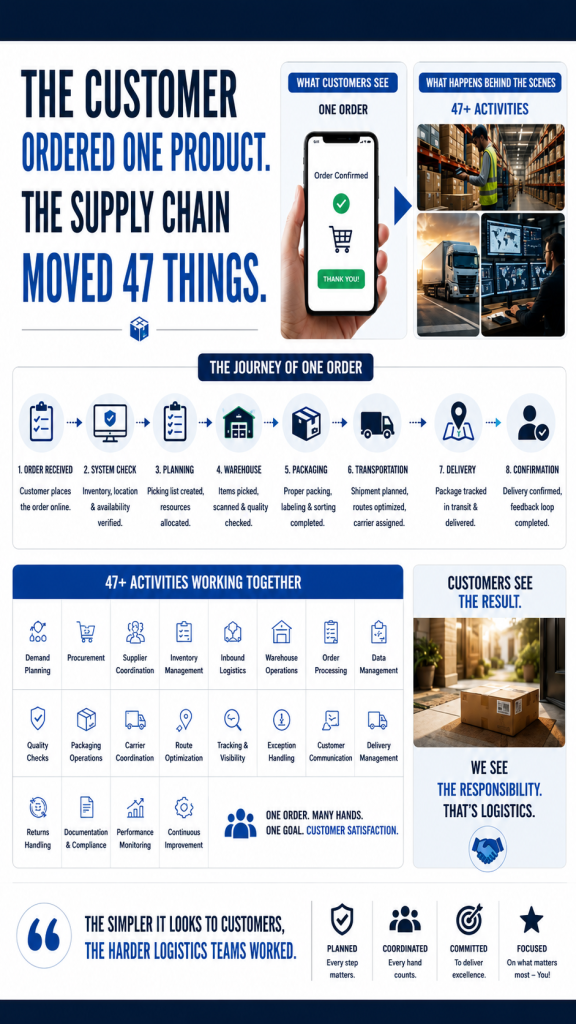
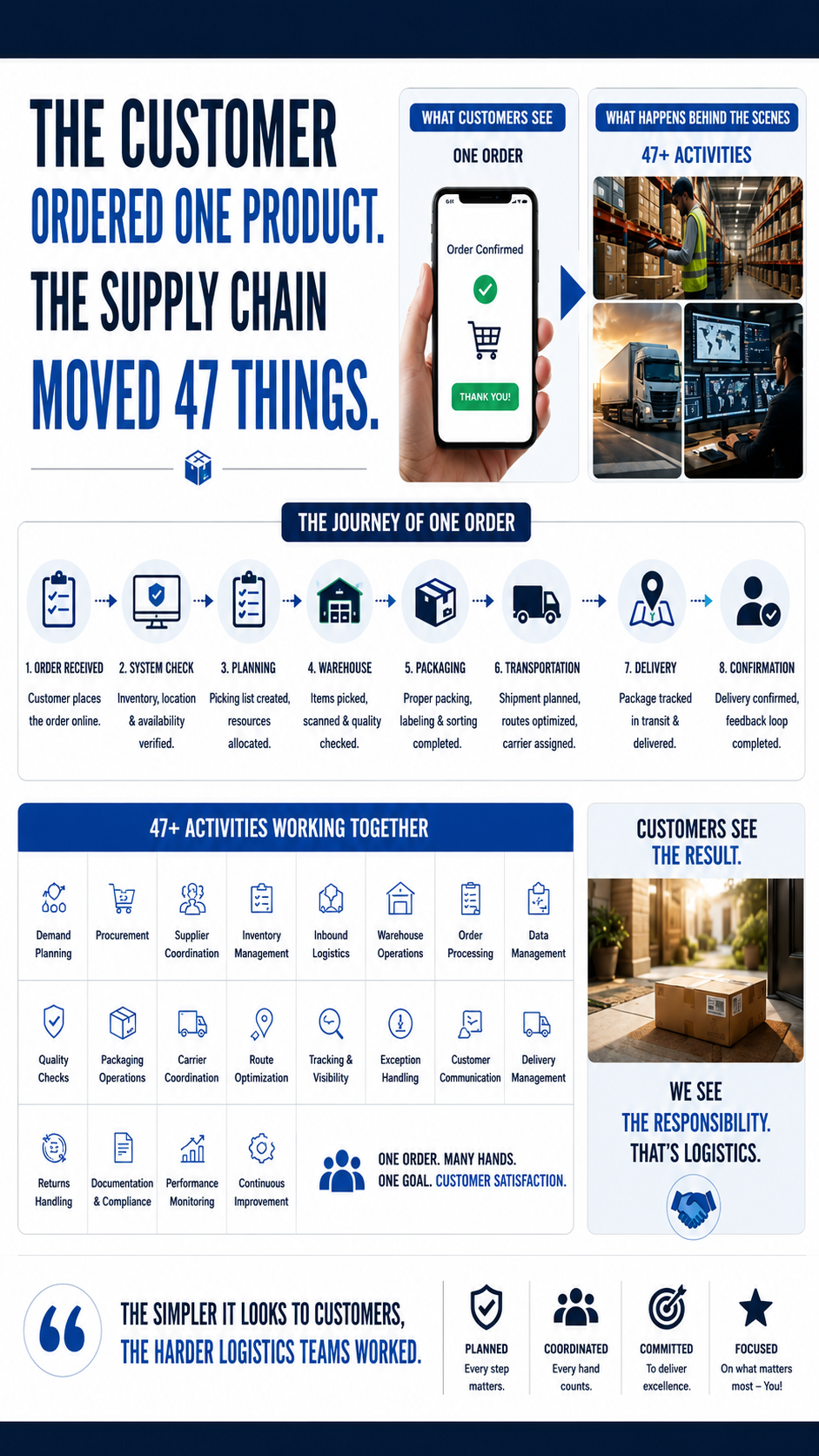
But behind that simple customer experience sits a complex, coordinated and often invisible supply chain. The customer ordered one product, but the supply chain may have moved, checked, planned, verified, packed, routed, tracked and managed dozens of connected activities to make that one delivery happen.
That is the real message behind the image: customers see the result, but logistics teams carry the responsibility.
The simple order is never simple
Modern customers are used to speed, visibility and convenience. They expect stock to be available, payment to work, orders to be confirmed, delivery dates to be accurate and parcels to arrive where and when promised.
From the customer’s perspective, it is one order.
From the supply chain perspective, it is a chain of decisions.
The moment the order is placed, a sequence of activity begins. The system checks whether the product is available. Inventory records are reviewed. The order is validated. The warehouse is notified. A picking task is created. The item must be located, picked, checked, packed, labelled, sorted and moved into the transport network.
Then comes the next stage. The shipment must be allocated to a carrier, loaded correctly, routed efficiently, tracked in transit and delivered to the right address. If something goes wrong, the exception must be managed. If the customer asks a question, the service team needs accurate information. If the item is returned, another process begins.
The customer sees one delivery. The supply chain sees demand planning, procurement, supplier coordination, inventory management, inbound logistics, warehouse operations, order processing, data management, packaging, transport, tracking, customer communication, returns and continuous improvement.
That is why logistics matters.
The hidden work behind customer satisfaction
Good logistics is often invisible. When it works well, nobody notices. The parcel arrives, the shelf is full, the production line keeps moving, the spare part is available, the customer is satisfied.
But that invisibility can be dangerous. It can lead people to undervalue the work involved.
A smooth delivery is not luck. It is the result of planning, coordination and professional judgement. It depends on accurate data, reliable suppliers, trained people, robust systems and well-designed processes.
Every successful order depends on multiple teams working together. Demand planners forecast what customers are likely to need. Procurement teams ensure supply is available. Inventory teams decide what to hold and where. Warehouse teams manage storage, picking and dispatch. Transport teams move goods through networks. Data teams keep systems accurate. Customer service teams manage communication. Leaders monitor performance and remove blockers.
One order. Many hands. One goal: customer satisfaction.
Why the number of activities matters
The image refers to “47+ activities” working together. The exact number will vary depending on the organisation, product, sector and delivery model. Some supply chains may involve fewer steps. Others, especially in defence, healthcare, engineering, food, pharmaceuticals or global manufacturing, may involve far more.
But the point is not the exact number.
The point is that supply chain activity is interconnected. A simple customer outcome depends on a network of small actions being completed correctly and in the right sequence.
If the stock record is wrong, the order may fail.
If the supplier is late, the warehouse may not have the item.
If the product is poorly packaged, it may be damaged in transit.
If the transport plan is weak, the delivery may miss its slot.
If the data is inaccurate, the customer may be given the wrong information.
If returns are badly managed, value is lost and customer confidence is damaged.
Supply chains are systems. Each activity affects the next. That is why small failures can quickly become visible problems.
The supply chain is a customer experience function
Too often, logistics and supply chain teams are described as back-office functions. That view is outdated.
Supply chain is directly connected to customer experience. It determines whether promises made by marketing, sales and online platforms can actually be delivered. A business can have the best product, the best website and the best brand, but if the product is not available, not delivered, or not supported, the customer experience fails.
The supply chain is where the promise becomes real.
That is especially true in a world where customers expect speed and transparency. They do not only want the product. They want confirmation, tracking, delivery updates, clear returns and confidence that the organisation knows what it is doing.
Behind every “your order has been dispatched” message is a logistics network that had to work.
Why supply chain professionals deserve more recognition
The simpler it looks to customers, the harder logistics teams may have worked.
That is one of the most important lessons for organisations. A seamless customer experience usually reflects a great deal of effort behind the scenes. It reflects people solving problems before the customer ever sees them.
Supply chain professionals manage risk every day. They balance cost, service, resilience, stock, capacity, sustainability and customer expectation. They deal with uncertainty, late deliveries, supplier issues, system errors, demand changes, weather disruption, capacity constraints and operational pressure.
They are planners, problem-solvers, analysts, negotiators, coordinators and improvers.
Their work is not simply about moving boxes. It is about protecting service, enabling performance and delivering trust.
The lesson for leaders
Leaders should not judge logistics only when something goes wrong. They should understand the value created when things go right.
A successful supply chain needs investment in people, systems, data, process design and continuous improvement. It needs accurate master data, realistic planning, clear ownership, skilled warehouse teams, reliable transport partners and strong supplier relationships.
It also needs recognition.
When an order arrives on time, that is not just a delivery success. It is a supply chain success. It is the visible output of many invisible activities working together.
Conclusion
The customer ordered one product.
But behind that one product sat planning, stock control, procurement, supplier management, warehousing, packaging, transport, tracking, customer communication, data management, exception handling and performance monitoring.
That is the power of supply chain.
Customers see the result. Logistics teams carry the responsibility.
And the better the supply chain performs, the simpler it looks.




Leave a Reply