
Why Supply Chain Illumination Needs Full PESTEL Analysis
From knowing who supplies us to understanding what we depend upon
Paul R Salmon FCILT – FSCM
Supply chains have become extraordinarily complex.
For decades, organisations have invested significant effort in understanding their immediate suppliers, monitoring supplier performance and improving the efficiency of the movement of materials through their networks. Measures such as cost, lead time, OTIF, inventory availability and supplier performance have become standard components of supply chain management.
These remain important.
But they increasingly answer only part of the question.
A modern supply chain can be performing well today while carrying significant vulnerabilities that are largely invisible to the organisation relying upon it. A Tier 1 supplier may be financially healthy. Deliveries may be on time. Inventory may appear sufficient. Contractual performance may be green.
Yet several tiers below that supplier there may be a single manufacturer, factory, material, technology, logistics route or geographic dependency upon which the entire supply chain relies.
That dependency may be exposed to geopolitical tension, commodity shortages, extreme weather, energy disruption, regulatory change, labour shortages or technological obsolescence.
None of those risks will necessarily appear in traditional supplier performance measures until they begin to affect delivery.
By then, the opportunity to intervene may already have passed.
This is why organisations need to move beyond traditional supply chain visibility towards supply chain illumination.
And illumination itself is only the beginning.
To understand whether the dependencies that illumination reveals are resilient, organisations need to examine the environment surrounding them. This is where full Political, Economic, Social, Technological, Environmental and Legal — PESTEL — analysis becomes critical.
The combination of supply chain illumination and PESTEL analysis provides something far more powerful than a supplier map.
It creates the foundation for anticipatory supply chain resilience.
What is supply chain illumination?
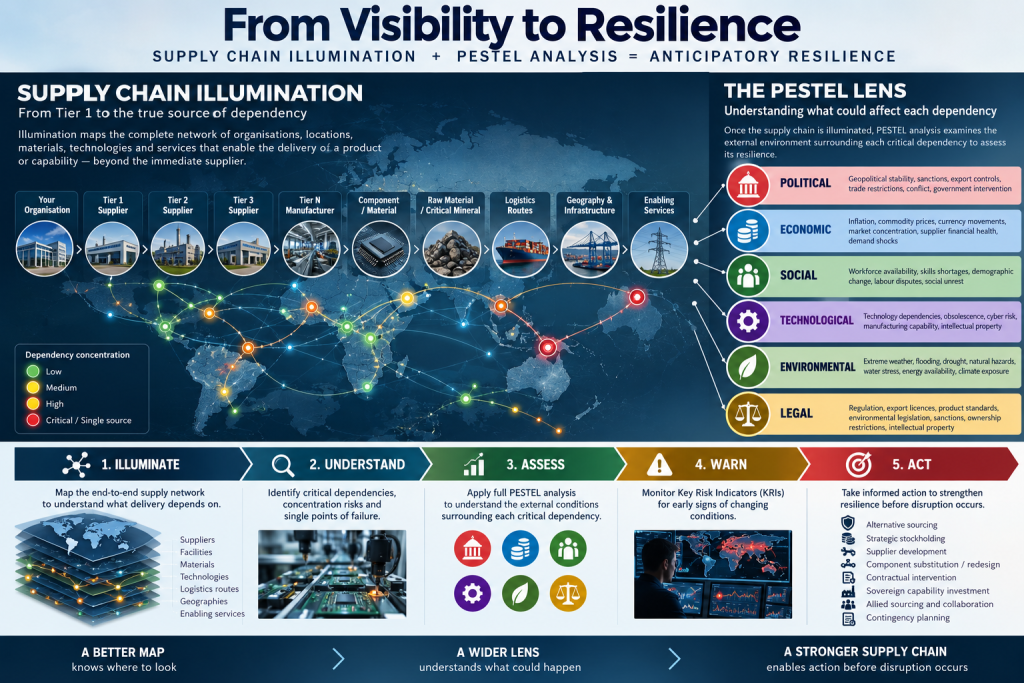
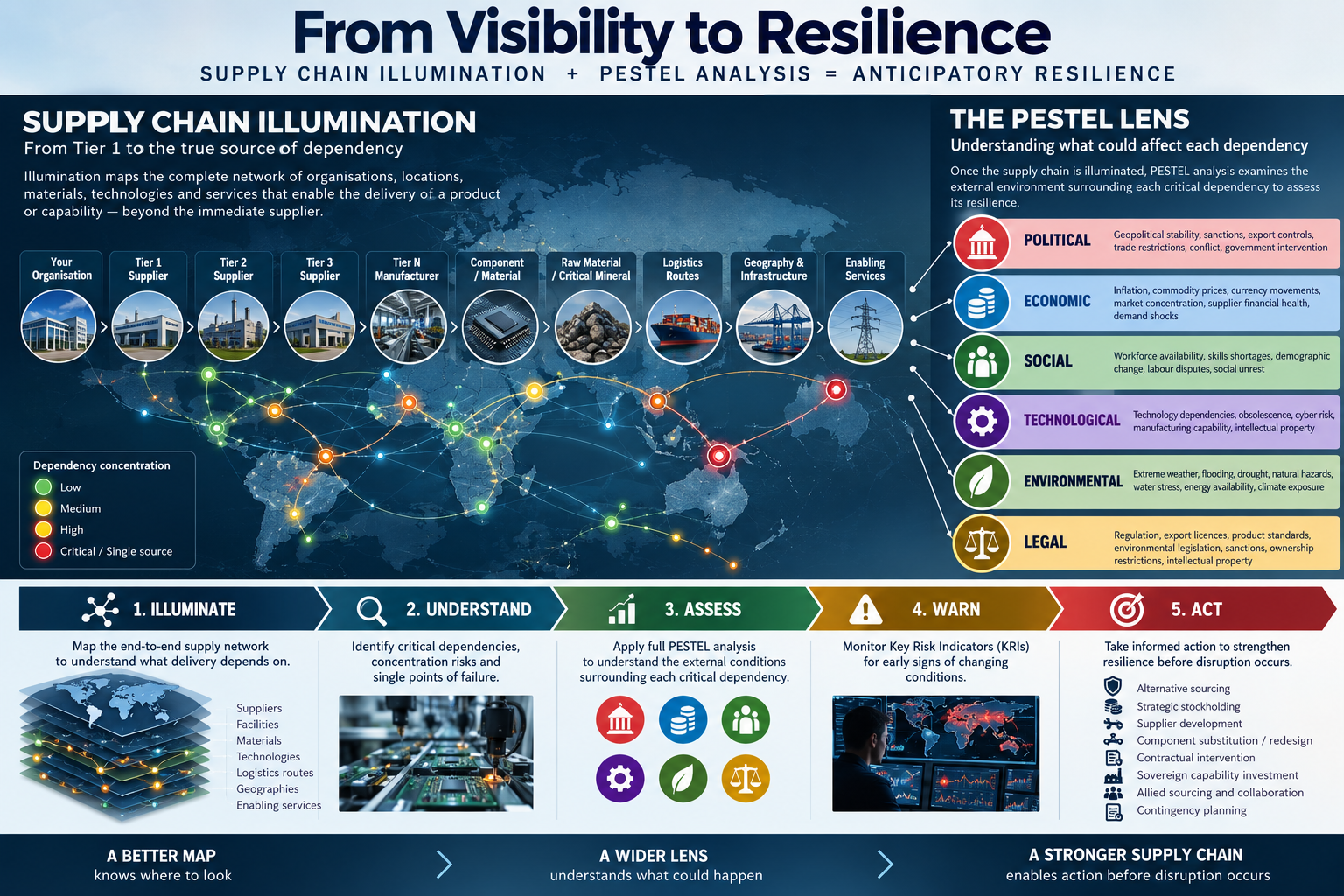
Supply chain illumination is the process of discovering, mapping and understanding the organisations, facilities, locations, materials, technologies and relationships that collectively enable the delivery of a product, service or capability.
Traditional supply chain visibility frequently concentrates on the contractual relationship:
Organisation → Tier 1 supplier
More advanced approaches may extend this to Tier 2 or Tier 3 suppliers.
Illumination seeks to go further.
It attempts to understand the supply network as it actually exists:
Organisation → Tier 1 → Tier 2 → Tier 3 → Tier N → manufacturer → material → raw material → critical mineral → geography → infrastructure → logistics routes → enabling services
This distinction matters.
Organisations generally understand the companies with which they hold contracts. They may know considerably less about the organisations supporting those suppliers.
Yet risk does not respect contractual boundaries.
A failure four or five tiers into the supply network can ultimately have exactly the same operational consequence as a failure at Tier 1.
Consider a sophisticated engineered product.
The organisation buying that product may contract with a major prime supplier. That supplier may source a subsystem from another company. That company purchases specialist electronics from another manufacturer, which relies on semiconductors fabricated elsewhere. Those semiconductors require materials processed in another country and transported through several international logistics nodes.
From a contractual perspective, the organisation has one supplier.
From a resilience perspective, it may have dozens — potentially hundreds — of dependencies.
Supply chain illumination seeks to expose them.
The fundamental question therefore changes from:
“Who are our suppliers?”
to:
“What does delivery of our capability ultimately depend upon?”
That is a substantially more important question.
The hidden problem of Tier N
One of the greatest challenges in modern supply chains is that vulnerability frequently exists below the level at which organisations have direct visibility.
Tier 1 suppliers are normally known.
Tier 2 suppliers may sometimes be understood.
Beyond that, visibility often deteriorates rapidly.
But deep within these extended networks can sit highly significant dependencies: a sole-source component manufacturer; a specialist chemical producer; a critical mineral refinery; a unique piece of manufacturing equipment; a particular semiconductor fabrication plant; a port or transport corridor; or a highly specialised workforce.
Any one of these could become a single point of failure.
The challenge is compounded by aggregation.
Multiple Tier 1 suppliers may appear independent while unknowingly depending upon the same Tier 3 or Tier 4 organisation.
An organisation might therefore believe that it has diversified its supply base because it buys from three different suppliers.
Illumination may reveal that all three ultimately depend upon the same sub-tier manufacturer.
The apparent resilience created through diversification is therefore an illusion.
This is one reason supply chain illumination is becoming increasingly important.
It exposes common dependencies, concentration risks and single points of failure that traditional supplier management may not reveal.
But identifying those dependencies is not enough.
Knowing that a critical component originates from a particular factory or country does not tell us whether that dependency is becoming more or less resilient.
For that, we need context.
From illumination to understanding
A supply chain map can tell us what is there.
It cannot, on its own, tell us what might happen to it.
Imagine that illumination identifies a Tier 4 manufacturer responsible for a specialist component used across several strategically important products.
That discovery is valuable.
But what is the risk?
Is the supplier financially stable?
Is the country politically stable?
Could new export controls affect the component?
Does the manufacturing process depend upon scarce energy or water?
Are there alternative manufacturers?
Does production depend upon specialist skills that are becoming increasingly scarce?
Is the technology approaching obsolescence?
Could environmental regulation restrict the materials used in production?
Is the logistics route vulnerable to disruption?
Could sanctions affect ownership, banking, insurance or transportation?
Suddenly, supply chain resilience becomes much broader than supplier management.
This is why PESTEL analysis provides an essential second lens.
Why PESTEL?
PESTEL analysis is often taught as a strategic management framework.
Its application to supply chain resilience, however, is particularly powerful because it forces organisations to consider risk across multiple dimensions rather than viewing resilience through a predominantly commercial or operational lens.
Political
Political factors include geopolitical instability, conflict, government intervention, sanctions, export controls, trade restrictions and changes in international relationships.
Modern supply chains frequently cross multiple jurisdictions. A relatively small political decision can therefore have consequences many tiers away from the organisation ultimately consuming the product.
The key question becomes:
Where are our critical dependencies exposed to political change?
Economic
Economic analysis considers factors including inflation, commodity prices, exchange rates, market concentration, supplier financial health, capital availability and demand shocks.
A critical supplier does not have to fail completely to create disruption.
Rapid increases in energy, raw-material or financing costs can reduce capacity, alter supplier behaviour or make production economically unsustainable.
Illumination allows these economic indicators to be connected to the specific parts of the supply network they could affect.
Social
Supply chains ultimately depend upon people.
Demographic change, workforce availability, industrial relations, migration, specialist skills and social instability can all affect supply.
A manufacturing facility may appear resilient until analysis reveals that production relies upon a small and ageing specialist workforce for which there is no readily available replacement.
That is a supply chain risk, even though it may initially appear to be a workforce issue.
Technological
Technology creates both opportunity and dependency.
Organisations increasingly rely upon semiconductors, specialist software, automation, digital infrastructure and proprietary manufacturing technologies.
Technological analysis should therefore examine issues including obsolescence, cyber exposure, intellectual property, technological concentration and the availability of alternative technologies.
A product may have multiple physical suppliers while still depending upon one underlying technology.
Environmental
Environmental risk is becoming increasingly significant within global supply networks.
Flooding, drought, extreme heat, wildfires, storms, water scarcity and energy availability can directly affect production and transportation.
The important point is geographical specificity.
It is not enough to know that climate or environmental risk exists globally. Organisations need to understand which specific nodes within their supply network are exposed to which environmental conditions.
Illumination provides the location.
Environmental intelligence provides the warning.
Legal
Finally, supply chains operate within increasingly complex regulatory environments.
Export licensing, sanctions, product regulation, environmental legislation, intellectual property restrictions, ownership rules and due-diligence requirements can all affect the availability of goods and materials.
A supplier does not need to physically stop producing for supply to become unavailable.
A regulatory decision can have the same effect.
Why all six dimensions matter
The value of PESTEL lies not simply in examining six separate categories of risk.
Its real power comes from understanding how those categories interact.
Consider a critical mineral.
Its supply might simultaneously be affected by political tensions in the producing country, increasing global demand, limited processing technology, environmental concerns around extraction, local community opposition and new regulatory requirements.
Examining only financial health would miss most of the risk.
Looking only at geopolitics would also be insufficient.
Supply chain disruption is frequently the product of multiple interacting pressures rather than one isolated event.
Full PESTEL analysis therefore reduces the danger of creating resilience strategies based upon an incomplete understanding of the environment.
From KPIs to KRIs
This also highlights an important distinction between Key Performance Indicators and Key Risk Indicators.
Supply chain organisations are generally very good at measuring performance.
We measure delivery.
We measure cost.
We measure inventory.
We measure lead times.
We measure supplier quality.
These KPIs tell us whether the supply chain is performing.
They do not necessarily tell us whether the supply chain is becoming vulnerable.
A supplier could achieve 100 per cent OTIF this month while operating a factory in an area approaching severe water shortage.
A component could currently be readily available while depending upon a material increasingly subject to export controls.
A supplier could meet every contractual measure while depending upon a financially distressed Tier 3 company.
Everything remains green — until suddenly it does not.
This is where KRIs become important.
A mature resilience capability should therefore connect external indicators to illuminated dependencies.
The objective is not simply to identify disruption.
It is to identify the conditions that could create disruption early enough to do something about them.
Illumination → Understand → Assess → Warn → Act
A useful way of describing this emerging approach is through five stages:
ILLUMINATE
Identify the end-to-end supply network, including suppliers, sub-tier suppliers, facilities, materials, technologies, logistics routes and geographic dependencies.
UNDERSTAND
Determine which of those dependencies are critical, concentrated, difficult to substitute or potentially single points of failure.
ASSESS
Apply the full PESTEL lens to understand the external conditions surrounding those critical dependencies.
WARN
Develop KRIs and data feeds capable of detecting changes in those conditions.
ACT
Use that intelligence to support timely interventions.
This final stage is perhaps the most important.
The objective of supply chain illumination should never simply be to produce a more sophisticated visualisation.
A better map is not the outcome. A better decision is.
Turning intelligence into intervention
Once organisations understand both their dependencies and the external conditions surrounding them, they can make more informed resilience decisions.
Those interventions might include alternative sourcing, increased inventory, supplier development, component substitution, redesign, changes to contractual arrangements, diversification of logistics routes, strategic stockholding, investment in domestic capacity or collaboration with international partners.
The appropriate response will vary according to the dependency.
But importantly, intervention can occur before the disruption happens.
That represents a fundamental change in supply chain management.
Traditional disruption management asks:
“Something has happened. What is affected?”
An illuminated, PESTEL-informed supply chain should increasingly be able to ask:
“Conditions are changing. What could be affected, when might it matter, and what can we do now?”
That is the transition from reactive supply chain management towards anticipatory resilience.
The role of data and digital capability
Achieving this at scale will clearly require digital capability.
No organisation can manually monitor thousands of suppliers, locations, materials and external indicators.
The opportunity therefore lies in combining internal supply chain information with external data.
Trade data, corporate information, commodity markets, sanctions information, shipping movements, weather and environmental data, geopolitical intelligence, regulatory information and technology indicators can increasingly be brought together.
Artificial intelligence and advanced analytics offer the potential to identify relationships and patterns within those datasets that would be extremely difficult for human analysts to identify manually.
However, technology should not become the objective.
A sophisticated digital platform containing enormous quantities of data is of limited value if it does not support decisions.
The design principle should therefore remain:
What decision will this information enable?
A new definition of visibility
Perhaps the biggest change required is conceptual.
For many years organisations have pursued greater supply chain visibility.
But visibility itself is no longer enough.
Knowing that a supplier exists is visibility.
Knowing where it operates is better visibility.
Knowing who supplies that supplier is illumination.
Understanding the political, economic, social, technological, environmental and legal conditions surrounding that dependency is intelligence.
Recognising that those conditions are changing is warning.
Taking action before they affect supply is resilience.
These are fundamentally different levels of maturity.
Conclusion: from visibility to anticipation
The supply chains upon which modern organisations depend are increasingly interconnected, international and exposed to events far beyond the traditional boundaries of procurement and logistics.
Understanding Tier 1 suppliers is no longer sufficient.
Even understanding Tier 2 and Tier 3 may not be enough.
Organisations need to understand the complete chain of dependencies supporting their most important products and capabilities.
That is the purpose of supply chain illumination.
But illumination should not be confused with resilience.
Illumination tells us where to look.
PESTEL tells us what to look for.
KRIs tell us when conditions are changing.
Decision processes determine what we do about it.
Together they create a powerful progression:
ILLUMINATE → UNDERSTAND → ASSESS → WARN → ACT
This is the real opportunity.
The future of supply chain resilience is not simply having greater visibility of disruption after it occurs.
It is developing the ability to recognise the conditions that could create disruption, understand which critical dependencies they threaten and intervene while there is still time to change the outcome.
In increasingly volatile and interconnected supply networks, that distinction matters.
Because the ultimate purpose of supply chain illumination is not to know more about the supply chain.
It is to ensure that we are better prepared for what happens next.