
By Paul R Salmon FCILT, FSCM
The supply chain profession is changing. By 2035, the most effective supply chain professionals will not be defined by a single job title, function or process. They will be systems thinkers, data translators, risk managers, sustainability leaders, commercial partners and change agents.
Traditional supply chain skills will still matter. Forecasting, procurement, inventory management, warehousing, supplier management, logistics, demand planning and customer service will remain central to organisational performance. However, the context in which those skills are applied is changing rapidly.
The supply chain professional of the future will need to understand not only what is happening across the supply chain, but why it is happening, what may happen next, and what decisions need to be made before disruption becomes failure.
The future professional will need to move beyond functional delivery and become an integrator of people, process, data, technology, suppliers and customers.
Why the role is changing
Supply chains are now operating in a world shaped by volatility, uncertainty and increasing expectation. Organisations are facing pressure from geopolitical disruption, changing customer behaviour, cost inflation, skills shortages, sustainability requirements, digital transformation and growing scrutiny of supplier performance.
Supply chain is no longer a hidden back-office function. It is central to business resilience, national capability, customer confidence, cashflow, operational performance and long-term competitiveness.
A late delivery is not simply a transport issue. It can affect production, service levels, contractual performance and customer trust.
Poor inventory data is not simply an administrative problem. It can lead to overbuying, shortages, write-offs, increased working capital and reduced availability.
A weak supplier relationship is not simply a procurement issue. It can become a resilience risk, reputational risk, ethical risk, cyber risk or commercial risk.
By 2035, the best supply chain professionals will be those who can see these connections and act across them.
1. The supply chain professional as a data translator
The supply chain professional of 2035 will not necessarily need to be a data scientist, but they will need to be data literate.
They will need to understand dashboards, forecasts, demand signals, master data, supplier performance, inventory health, lead-time variation, cost drivers and carbon data. More importantly, they will need to translate data into decisions.
Many organisations already have more data than they can use effectively. They collect data, report data and visualise data, but they do not always convert it into meaningful action.
The future professional will need to ask better questions:
* Is this data accurate enough to support a decision?
* What assumptions sit behind the forecast?
* What does this trend really tell us?
* What is the risk if we do nothing?
* What decision is this dashboard designed to support?
* Who owns the action that follows from the insight?
This matters because technology will increasingly shape supply chain decision-making. Artificial intelligence, automation, predictive analytics and digital planning tools will support forecasting, inventory optimisation, supplier risk monitoring, warehousing and transport planning.
But technology will not remove the need for professional judgement.
Poor data, unclear ownership and weak process discipline will not be solved by technology alone. In fact, advanced systems can make poor decisions faster if the data and assumptions behind them are wrong.
The supply chain professional of 2035 will therefore need to be comfortable using data, challenging data and explaining data in language that leaders, suppliers and operational teams can understand.
2. The supply chain professional as a systems thinker
Supply chains do not operate in neat departmental boxes. A decision made in one area often creates consequences elsewhere.
A procurement decision can create an inventory problem. An inventory policy can create a warehouse problem. A warehouse constraint can create a transport problem. A transport delay can create a customer service problem. A customer service problem can become a commercial problem.
That is why systems thinking will become one of the defining skills of the future supply chain professional.
Systems thinking means seeing the whole chain, not just one link. It means understanding the relationships between demand, supply, inventory, capacity, cost, service, risk and sustainability.
For example, reducing inventory may improve working capital in the short term, but increase operational risk if supplier lead times are unstable. Selecting a lower-cost supplier may reduce purchase price, but increase total cost if quality problems, delays or minimum order quantities create further disruption. Automating a warehouse may improve throughput, but only if demand patterns, packaging data, maintenance support, workforce skills and process design are properly understood.
The supply chain professional of 2035 will need to think beyond local optimisation. They will need to understand total system performance.
The critical question will be:
What happens elsewhere in the system if we make this decision here?
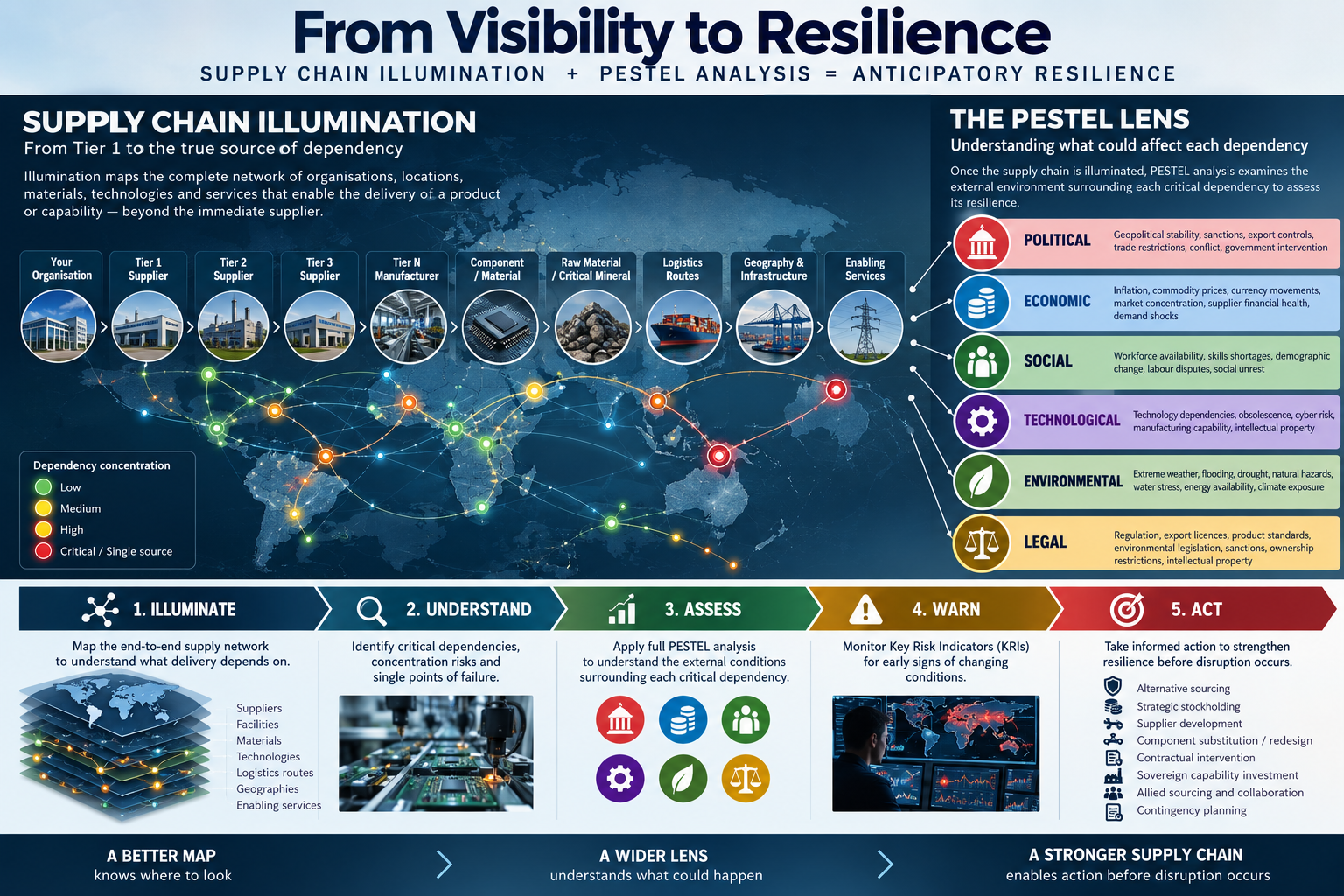
3. The supply chain professional as a risk manager
Disruption is no longer an occasional exception. It is part of the operating environment.
Geopolitical instability, extreme weather, cyber threats, supplier failure, labour shortages, energy volatility, infrastructure constraints and regulatory change can all affect supply chain performance.
By 2035, supply chain risk management will need to be more than a periodic review or a static risk register. It will need to be live, structured and connected to decision-making.
The future professional will need to understand:
* critical suppliers
* single points of failure
* alternative sources of supply
* lead-time exposure
* transport chokepoints
* capacity constraints
* cyber and data risks
* inventory buffers
* contractual resilience
* recovery time after disruption
This does not mean holding excessive stock everywhere. Resilience is not simply about having more inventory. It is about understanding where vulnerability exists and designing appropriate responses.
In some cases, the answer may be additional stock. In others, it may be dual sourcing, supplier development, improved forecasting, commonality of parts, local repair capability, better data visibility, revised contracts or more flexible capacity.
The supply chain professional of 2035 will need to balance efficiency and resilience. The profession must move beyond the idea that lean and resilient are opposites. The real challenge is knowing where efficiency is appropriate, where resilience is essential, and where the trade-off must be made visible to decision-makers.
4. The supply chain professional as a sustainability leader
By 2035, sustainability will not be an optional extra. It will be part of supply chain design, supplier selection, performance management and customer value.
Supply chain decisions have environmental consequences. Transport choices, packaging, warehouse operations, sourcing strategies, repair, reuse, disposal and returns management all affect carbon, waste and resource consumption.
The supply chain professional of the future will need to understand carbon as well as cost.
They will need to ask:
* What is the carbon impact of this route, supplier or operating model?
* Can packaging be reduced without damaging service or product integrity?
* Should we repair, refurbish, remanufacture or replace?
* Can waste be reduced through better planning or inventory control?
* Are suppliers able to provide credible sustainability data?
* What is the full-life impact of this decision?
This is not about turning every supply chain professional into an environmental specialist. It is about making sustainability part of normal supply chain thinking.
The cheapest option on a purchase order may not be the best option across the full life of a product. The lowest-cost route may not be the best route when carbon, reliability, resilience and customer expectations are considered.
The future professional will need to help organisations understand these trade-offs clearly and make better-informed choices.
5. The supply chain professional as a technology user, not a technology passenger
Automation, robotics, artificial intelligence, digital twins, control towers, predictive analytics and advanced planning systems will become increasingly common across supply chains.
These technologies will change the profession, but they will not remove the need for professional expertise.
The future supply chain professional will need to understand what technology can do, what it cannot do, and where human judgement remains essential.
They will need to challenge automated recommendations. They will need to understand exceptions. They will need to spot when the model does not reflect operational reality. They will need to recognise when a decision is technically efficient but practically wrong.
The risk is not simply that technology replaces people. The greater risk is that people become passive users of systems they do not understand.
The best professionals will use technology as a tool to improve decision-making, not as a substitute for thinking.
By 2035, supply chain professionals will need the confidence to work alongside technology, challenge outputs, interpret results and explain decisions to others.
6. The supply chain professional as a commercial partner
Supply chain is where strategy becomes reality.
An organisation may promise growth, faster delivery, improved service, lower cost, increased resilience or reduced carbon. But those promises are delivered through suppliers, inventory, warehousing, transport, people, systems and processes.
That means supply chain professionals must become stronger commercial partners.
They need to understand contracts, cost drivers, supplier incentives, service levels, working capital, whole-life cost, risk exposure and customer value. They must be able to explain trade-offs clearly to senior leaders.
For example:
* Faster delivery may increase cost.
* Lower inventory may increase risk.
* Cheaper sourcing may reduce resilience.
* Higher service levels may require additional capacity.
* Better sustainability may require different supplier choices.
* Automation may reduce labour dependency but increase technical support requirements.
The supply chain professional of 2035 will not simply report problems. They will help organisations understand choices.
They will need to be credible at the boardroom table, in the warehouse, with suppliers and with customers.
7. The supply chain professional as a lifelong learner
Perhaps the most important future skill will be the ability to keep learning.
The profession is changing too quickly for knowledge to remain static. A buyer will need to understand digital procurement. A planner will need to understand AI-supported forecasting. A warehouse manager will need to understand automation. A logistics manager will need to understand carbon reporting. An inventory manager will need to understand predictive analytics and resilience modelling.
The future belongs to professionals who continue to develop.
This does not mean that existing experience loses value. Quite the opposite. Operational experience will become even more important, but it will need to be combined with new tools, new data and new ways of thinking.
The supply chain professional of 2035 will need curiosity, adaptability and professional discipline.
They will need to learn continuously, challenge assumptions and remain open to new methods while still understanding the fundamentals of supply chain performance.
What skills will matter most by 2035?
The supply chain professional of 2035 will need a blend of technical, digital, commercial and human skills.
The most important are likely to include:
1. Data literacy — understanding data quality, dashboards, forecasts and performance measures.
2. Systems thinking — seeing how decisions affect the wider supply chain.
3. Commercial awareness — understanding cost, contracts, service and value.
4. Technology confidence — using AI, automation and digital tools intelligently.
5. Sustainability knowledge — considering carbon, waste and full-life impact.
6. Risk management — identifying vulnerabilities and designing resilience.
7. Communication — explaining complex trade-offs in clear language.
8. Change leadership — helping people adopt new processes, tools and behaviours.
9. Ethical judgement — understanding supplier behaviour, transparency and accountability.
10. Operational credibility — knowing how supply chains actually work in practice.
The final point is especially important. Technology, data and strategy are powerful, but they must be grounded in operational reality. A professional can have access to advanced systems and impressive dashboards, but if they do not understand how supply chains work in practice, they will struggle to make good decisions.
What this means for employers
Employers cannot wait until 2035 to build these skills.
The capability required for the future supply chain must be developed now. Organisations should be investing in professional development, data literacy, systems thinking, sustainability awareness, technology adoption and cross-functional learning.
They should also create career pathways that allow supply chain professionals to move across functions and understand the wider system. A planner who understands procurement will make better planning decisions. A buyer who understands warehousing and inventory will make better sourcing decisions. A warehouse manager who understands demand and forecasting will make better capacity decisions.
The supply chain workforce of the future will not be created by job titles alone. It will be created through experience, education, professional standards and deliberate development.
Conclusion: more than a planner, more than a buyer
The supply chain professional of 2035 will not be defined by a single function.
They will be part analyst, part operator, part commercial adviser, part risk manager, part technologist, part sustainability lead and part change agent.
They will need to understand data, but also people. They will need to use technology, but also challenge it. They will need to reduce cost, but also protect resilience. They will need to support growth, but also manage risk.
The future supply chain professional will not simply move goods, place orders or manage stock.
They will help organisations make better decisions.
That is why the profession matters.
The supply chain professional of 2035 will not just manage the chain. They will understand the system, shape the system and improve the system.


Leave a Reply