
The Essential Elements of End-to-End Supply Chain Excellence
By Paul R Salmon FCILT for the Supply Chain Council
Modern supply chains are among the most complex systems ever created. They connect raw material extraction, manufacturing, warehousing, transportation, inventory, data, finance, sustainability, and customer service into one interconnected operational ecosystem. Yet despite this complexity, many organisations still attempt to improve supply chain performance through isolated initiatives rather than understanding how the system functions as a whole.
A useful way to visualise this challenge is through what could be called The Supply Chain Periodic Table — a structured view of the core elements required to build, operate, optimise, and sustain an effective end-to-end supply chain.
Much like the periodic table in chemistry organises the building blocks of matter, the Supply Chain Periodic Table organises the building blocks of operational performance. It reminds us that supply chain excellence is not created through one capability alone. It is the interaction between planning, sourcing, manufacturing, logistics, returns, technology, data, people, and resilience that ultimately determines operational success.
The reality is simple: weak elements create weak supply chains.
Why Supply Chains Need a Systems View
Many organisations still optimise individual functions in isolation. Procurement focuses on cost reduction. Warehousing focuses on utilisation. Transport focuses on delivery speed. Finance focuses on inventory reduction. IT focuses on systems implementation.
Individually, these activities may appear successful.
Collectively, however, they often create operational friction.
For example:
- Procurement may source the cheapest supplier, increasing lead time risk.
- Warehousing may maximise storage density while reducing operational agility.
- Inventory reduction programmes may damage operational availability.
- Transport optimisation may increase handling complexity and damage rates.
- Technology implementation may digitise poor processes rather than improve them.
The supply chain does not behave like separate departments. It behaves like an interconnected operational network.
This is why the concept of a Supply Chain Periodic Table matters. It encourages leaders to think systemically rather than functionally.
The Six Core Supply Chain Domains
The Supply Chain Periodic Table can broadly be divided into six operational domains:
- Plan
- Source
- Make
- Deliver
- Return
- Enable
Each domain contains critical operational elements that must work together to achieve end-to-end performance.
PLAN — Creating Operational Synchronisation
Planning is the nervous system of the supply chain.
Without effective planning, even the best logistics infrastructure becomes reactive and unstable.
Core planning elements include:
- Demand Planning
- Sales & Operations Planning (S&OP)
- Inventory Planning
- Capacity Planning
- Network Design
- Performance Management
These activities establish operational balance between demand, supply, inventory, production, and transport capacity.
One of the most important realities in modern supply chains is that forecasting is no longer sufficient on its own. Organisations must now combine forecasting with:
- demand sensing,
- market intelligence,
- geopolitical awareness,
- disruption analysis,
- and real-time operational visibility.
In Defence supply chains, for example, forecasting assumptions based purely on historical consumption are increasingly dangerous. Conflict, sanctions, supplier fragility, cyber threats, and strategic competition can invalidate planning assumptions almost overnight.
The organisations that succeed will be those capable of dynamically adapting plans faster than disruption evolves.
SOURCE — The Strategic Supplier Ecosystem
Many organisations still treat sourcing as a transactional purchasing activity.
It is not.
Modern sourcing is about building and sustaining a resilient supplier ecosystem.
Critical sourcing elements include:
- Supplier Relationship Management
- Category Management
- Contract Management
- Supplier Quality
- Supplier Visibility
- Procurement Management
- Risk Management
The globalisation era encouraged organisations to optimise for cost efficiency. The resilience era now demands optimisation for survivability.
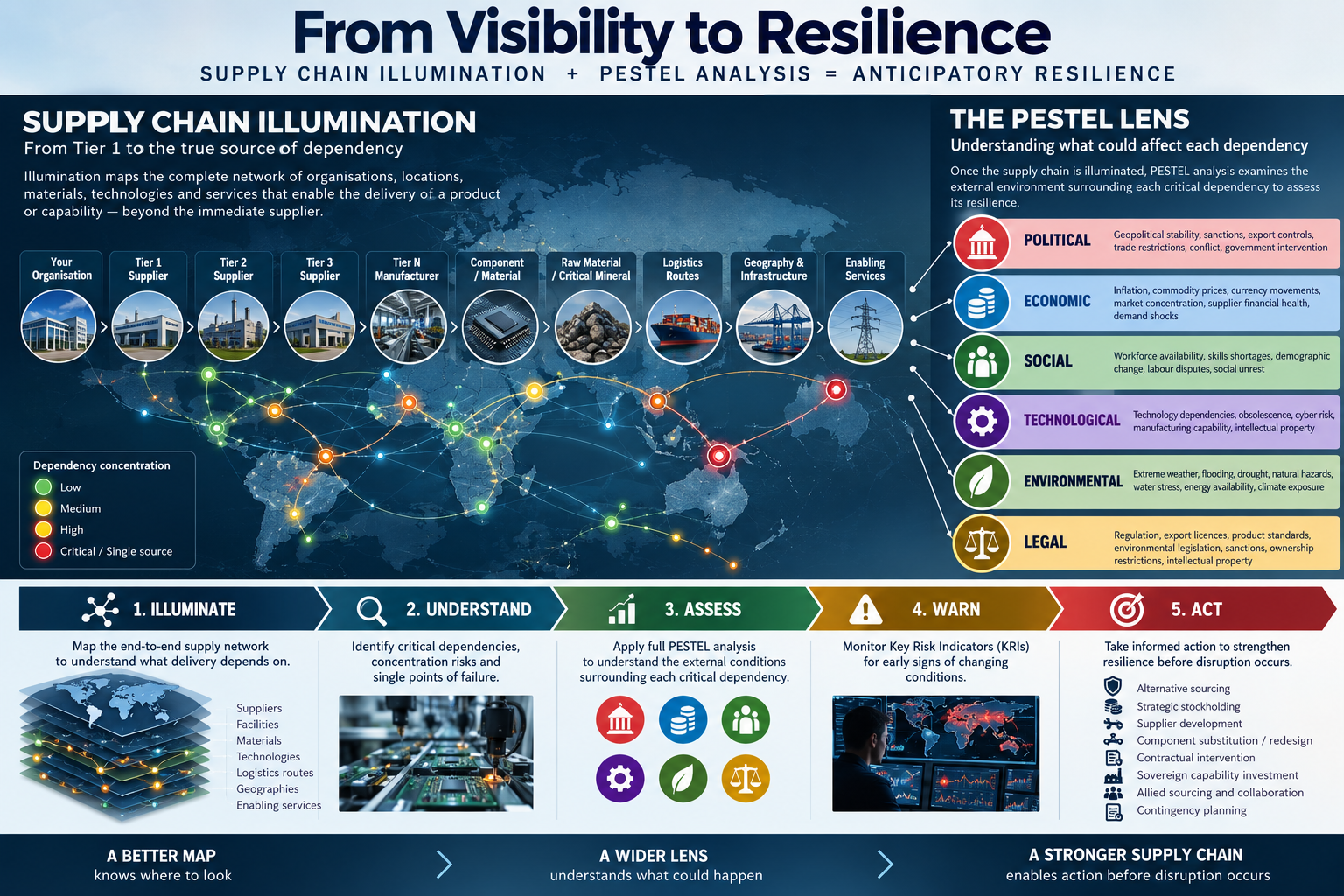
Recent years have demonstrated that organisations often have limited visibility beyond Tier 1 suppliers. In reality, many operational risks sit several layers deeper within the supply chain.
Examples include:
- rare earth dependencies,
- semiconductor bottlenecks,
- single-source castings,
- sovereign manufacturing limitations,
- and transportation choke points.
This creates strategic vulnerabilities.
The organisations that build supply chain resilience will be those capable of mapping and understanding their entire supply network rather than simply managing direct suppliers.
MAKE — Transforming Materials into Capability
Manufacturing remains one of the most operationally sensitive parts of the supply chain.
Core elements include:
- Production Planning
- Scheduling
- Work Management
- Materials Management
- Quality Control
- Manufacturing Operations
- Continuous Improvement
- Asset Utilisation
Modern manufacturing environments are increasingly influenced by:
- automation,
- AI,
- robotics,
- digital twins,
- predictive maintenance,
- and advanced analytics.
However, technology alone does not create operational excellence.
Poor data quality, inaccurate bills of material, weak planning assumptions, and disconnected workflows can rapidly undermine manufacturing performance.
One of the biggest mistakes organisations make is focusing purely on production throughput while ignoring flow stability.
A factory running at 100% utilisation may actually be less resilient than one operating at 80% with surge capacity.
This becomes especially important in Defence and critical national infrastructure supply chains where surge manufacturing capability may become strategically essential during crisis or conflict.
DELIVER — The Physical Movement of Value
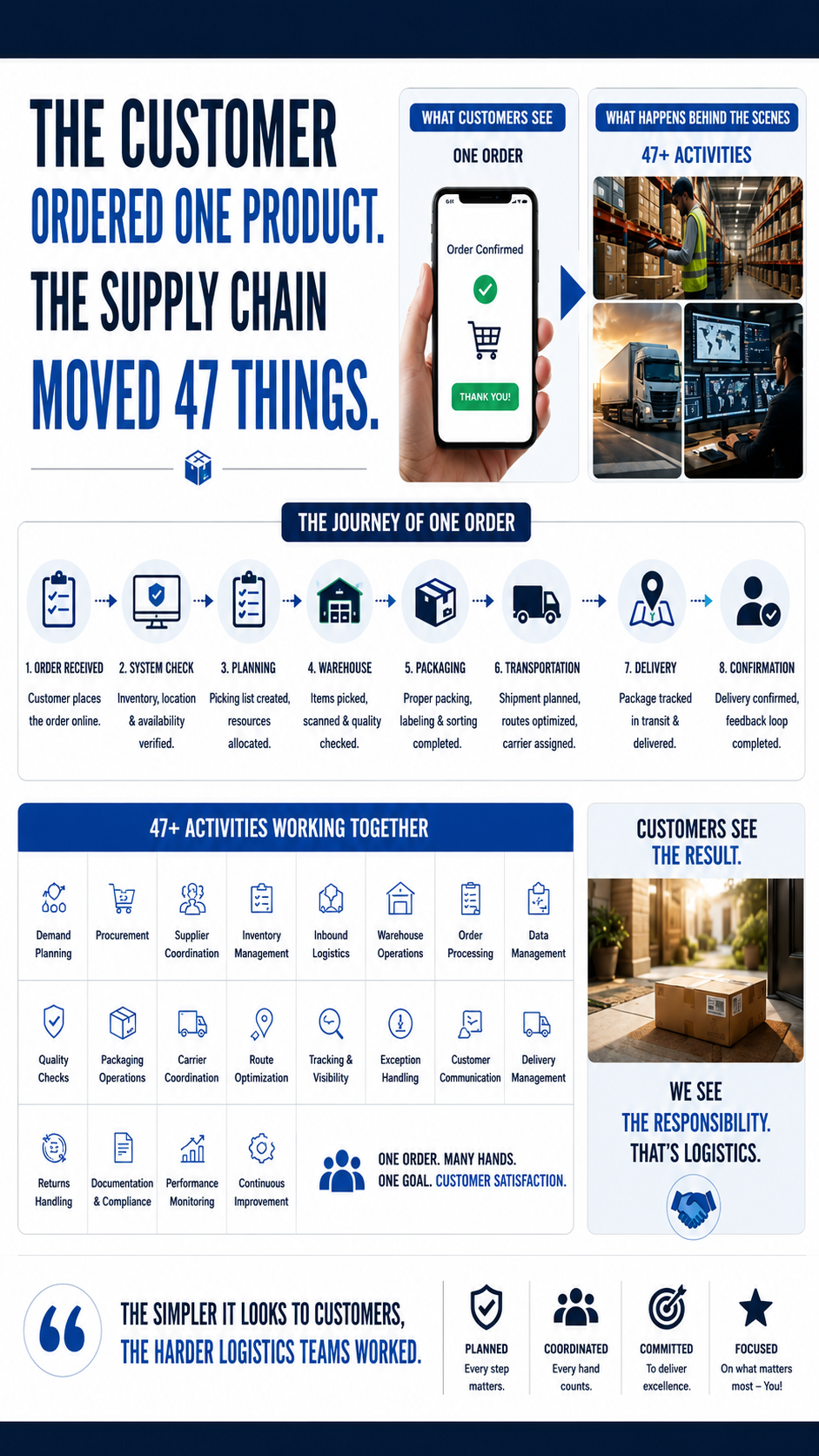
Delivery is where supply chains become visible to customers.
It includes:
- Order Management
- Warehousing
- Transportation Management
- Freight Management
- Last Mile Delivery
- Export/Import Management
- Visibility & Tracking
- Customer Service
This is often where operational complexity becomes most obvious.
Global supply chains now operate across:
- ports,
- airports,
- customs systems,
- road networks,
- rail infrastructure,
- digital platforms,
- and increasingly contested geopolitical environments.
The challenge is no longer simply moving products.
The challenge is orchestrating flow.
For example, organisations may have inventory available globally yet still fail operationally because:
- material is in the wrong location,
- packaging dimensions are incorrect,
- customs documentation is incomplete,
- transport capacity is constrained,
- or warehouses cannot process demand quickly enough.
In Defence logistics, this challenge becomes even more acute.
A submarine, aircraft carrier, or combat platform may have millions of pounds worth of spare parts available globally — yet still suffer reduced availability because the correct item could not be moved into the operational theatre at the required time.
Supply chains succeed or fail based on flow synchronisation.
RETURN — The Forgotten Supply Chain
Many organisations invest heavily in forward logistics while underestimating reverse logistics.
Yet returns management is becoming increasingly important due to:
- sustainability requirements,
- circular economy pressures,
- warranty management,
- repair loops,
- remanufacturing,
- and asset recovery.
Core return elements include:
- Returns Management
- Reverse Logistics
- Repair & Refurbishment
- Credits & Refunds
- Disposal & Sustainability
In many industries, reverse logistics is now a major operational capability rather than an afterthought.
This is particularly true in Defence where repairable assets, repair loops, component recovery, and equipment refurbishment significantly influence platform availability and operational readiness.
The future supply chain will not simply move products forward.
It will continuously recover, repair, reuse, and regenerate capability.
ENABLE — The Invisible Force Multipliers
The enablement layer is often overlooked because it is less physically visible than warehouses or transport fleets.
Yet these are the elements that hold the entire supply chain together.
Critical enablement capabilities include:
- Information Technology
- Data & Analytics
- People & Organisation
- Process Excellence
- Compliance & Governance
- ESG & Sustainability
Without these foundational capabilities, the operational system degrades rapidly.
Perhaps the most important enabler of all is data.
Poor-quality data damages:
- forecasting,
- inventory optimisation,
- transport planning,
- maintenance modelling,
- supplier visibility,
- warehouse efficiency,
- and strategic decision-making.
Organisations increasingly talk about AI-enabled supply chains, but AI is only as effective as the underlying data ecosystem.
Bad data simply creates faster bad decisions.
The Foundation Elements Beneath Every Supply Chain
Beneath all operational domains sit foundational elements that influence the entire ecosystem:
- Change Management
- Collaboration
- Knowledge Management
- Innovation
- Agility
- Resilience
- Customer Experience
- Value Optimisation
- Strategic Alignment
These are not optional.
They are force multipliers.
For example:
A technically advanced organisation without effective change management may fail transformation efforts.
A highly efficient supply chain without resilience may collapse during disruption.
A data-rich organisation without collaboration may still suffer decision latency.
The strongest supply chains are not those with the most technology.
They are the ones capable of adapting fastest under pressure.
The Future Supply Chain Will Be Digitally Orchestrated
The Supply Chain Periodic Table also highlights the future direction of the profession.
Tomorrow’s supply chains will increasingly rely upon:
- AI-driven planning,
- digital twins,
- predictive analytics,
- control towers,
- autonomous systems,
- real-time visibility,
- and integrated decision-support tools.
But technology alone is not the answer.
The future belongs to organisations capable of integrating:
- people,
- process,
- data,
- governance,
- and operational culture.
This is why supply chain capability must increasingly be viewed as a strategic national competence rather than purely an operational business function.
Final Thoughts
The Supply Chain Periodic Table is more than a visual concept.
It is a reminder that supply chains are interconnected operational ecosystems where every element matters.
Weak planning damages sourcing.
Weak sourcing damages manufacturing.
Weak manufacturing damages delivery.
Weak data damages everything.
Organisations that continue treating supply chains as fragmented functions will increasingly struggle in an era defined by volatility, disruption, geopolitical competition, and operational uncertainty.
The future belongs to organisations capable of understanding the full system.
Because ultimately:
Strong elements create connected systems. Connected systems create operational advantage.


Leave a Reply