
By Paul R Salmon FCILT, for the Supply Chain Council
Introduction: Experience Is Not the Same as Exposure
Military careers are built on experience.
From the first day in uniform, individuals are immersed in operational environments that demand discipline, resilience, and delivery under pressure. Over time, that experience becomes deep, valuable, and often hard-earned.
But there is a difference between experience and exposure.
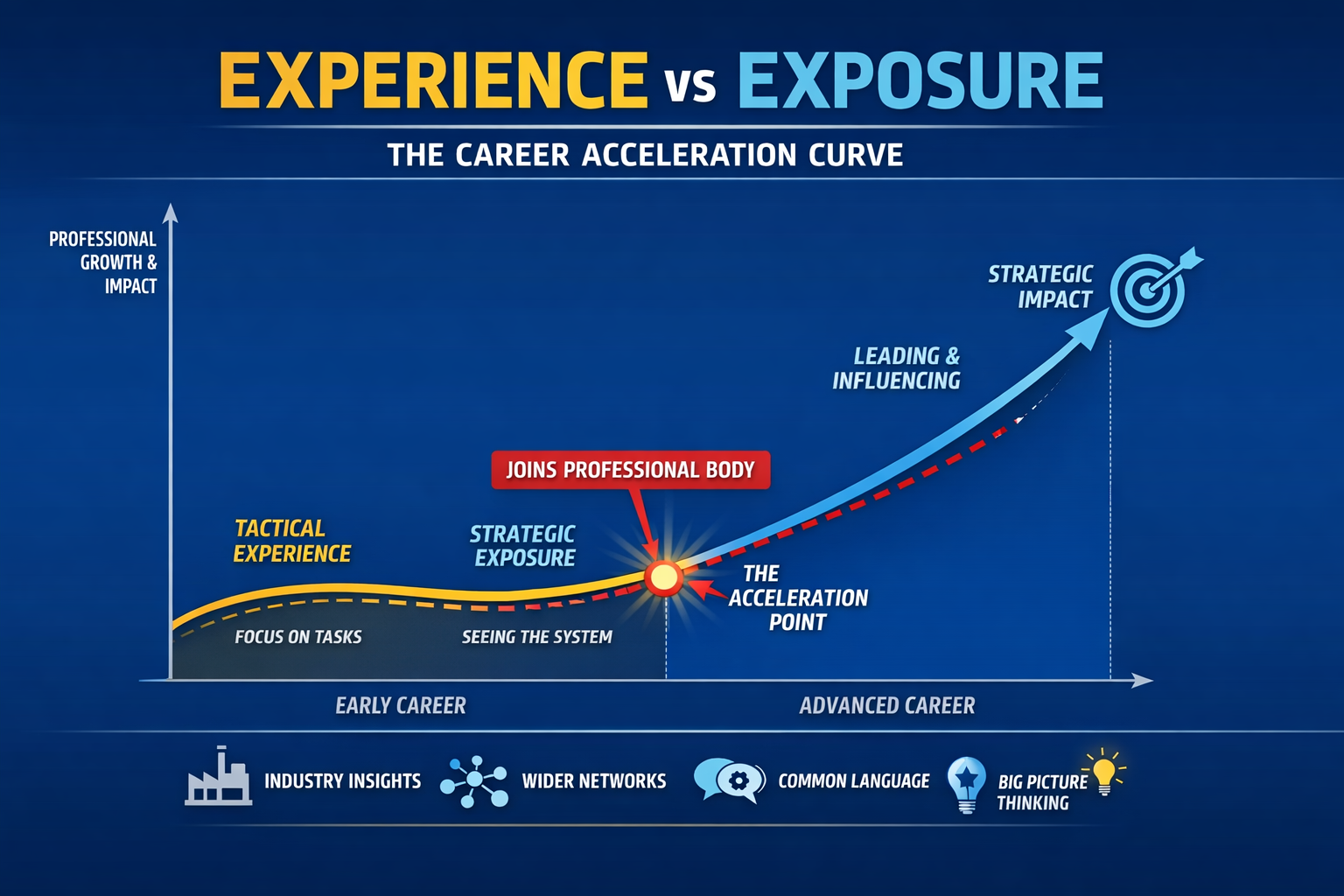
Experience teaches you how to do your job.
Exposure teaches you how your job fits into the system.
Looking back over a career in Defence logistics and support, one of the clearest reflections is this:
If I knew then what I know now, I would have joined a professional body on day one.
Not for accreditation. Not for status.
But for the perspective it provides—and the acceleration it gives to professional growth.
The Early Career Trap: Tactical Excellence, Strategic Blindness
In the early stages of a military career, the focus is understandably narrow:
- Deliver the task
- Support the mission
- Solve immediate problems
- Learn from those around you
This creates strong tactical operators—people who can execute under pressure and deliver outcomes.
However, it also creates a common challenge:
Many individuals become highly effective within their role—but lack visibility of the wider system they are part of.
In logistics and supply chain roles, this is particularly significant.
A junior logistician might:
- Manage inventory
- Coordinate movements
- Support maintenance
- Deliver operational outputs
But they may not fully understand:
- How demand is generated
- How supply chains are designed
- The cost implications of decisions
- The trade-offs between availability, cost, and resilience
- How industry partners operate
Without that wider exposure, development can plateau—not because of lack of ability, but because of lack of context.
The Missing Link: Professional Bodies as System Accelerators
This is where professional bodies play a critical role.
Organisations like the Chartered Institute of Logistics and Transport provide something that is difficult to replicate within a single organisation—particularly within Defence:
A cross-sector, system-level view of the profession.
They bring together:
- Defence
- Industry
- Academia
- Government
- Emerging professionals
Into a single professional ecosystem.
For an individual early in their career, this offers immediate access to:
- Best practice beyond Defence
- Shared language and frameworks
- Professional standards
- External perspectives on familiar problems
In effect, they shorten the time it takes to move from:
“I understand my role”
to
“I understand the system.”
Why This Matters in Defence Supply Chains
Defence supply chains are among the most complex in the world.
They operate across:
- Multiple domains (land, sea, air, cyber, space)
- Global supplier networks
- Long equipment lifecycles
- Uncertain and contested environments
And they must balance:
- Operational availability
- Cost control
- Risk management
- Sustainability
- Sovereignty
Yet, many of the challenges faced in Defence are not unique.
Industry deals with:
- Demand volatility
- Supply disruption
- Cost pressures
- Data challenges
- Technological change
The difference is often scale, consequence, and context—not the underlying principles.
Professional bodies provide the bridge between these worlds.
They allow Defence professionals to:
- Learn from industry innovation
- Share Defence challenges in a structured way
- Apply proven methodologies in new contexts
- Avoid reinventing solutions that already exist
The Power of a Common Language
One of the most underestimated benefits of joining a professional body early is the development of a common professional language.
In Defence, terminology can be:
- Organisation-specific
- Platform-specific
- Historically evolved
- Inconsistently applied
This creates friction when:
- Working across teams
- Engaging with industry
- Translating requirements
- Making strategic decisions
Professional bodies introduce:
- Standard definitions
- Recognised frameworks
- Shared methodologies
Whether it is:
- Supply chain segmentation
- Demand forecasting
- Inventory optimisation
- Network design
- Whole-life cost modelling
Having a common language:
- Improves decision-making
- Reduces misunderstanding
- Accelerates collaboration
From Practitioner to Professional
There is a fundamental shift that occurs when individuals engage with a professional body:
They move from being practitioners of a role to professionals within a discipline.
This shift is subtle—but powerful.
A practitioner:
- Focuses on tasks
- Delivers outputs
- Operates within a defined scope
A professional:
- Understands principles
- Applies judgement
- Influences systems
- Thinks beyond immediate tasks
Joining early accelerates this transition.
It encourages individuals to:
- Reflect on what they are doing—and why
- Connect their work to broader outcomes
- Develop structured thinking
- Engage with continuous professional development (CPD)
Confidence: The Hidden Benefit
Perhaps the most overlooked impact of early professional engagement is confidence.
Not confidence in rank or role—but confidence in:
- Knowledge
- Understanding
- Voice
- Perspective
Many individuals in Defence underestimate the value of their experience because:
- It is framed internally
- It lacks external comparison
- It is not translated into professional language
Engagement with a professional body changes that.
It provides:
- Validation of skills
- Benchmarking against industry
- Opportunities to contribute
- Platforms to share ideas
Over time, this builds confidence to:
- Challenge assumptions
- Engage at higher levels
- Influence decisions
- Lead change
Networks: The Long-Term Force Multiplier
Careers in Defence are often structured and hierarchical.
Professional networks, however, are:
- Broad
- Diverse
- Cross-sector
- Long-lasting
Joining early allows individuals to build relationships that:
- Extend beyond their immediate role
- Continue beyond their military career
- Provide opportunities for collaboration
- Support transition to civilian roles
These networks become a force multiplier—not just for individuals, but for the organisations they represent.
Bridging Defence and Industry
One of the strategic challenges facing Defence is the integration with industry partners.
Modern capability depends on:
- Strong Defence–industry relationships
- Shared understanding
- Collaborative problem-solving
- Mutual trust
Professional bodies act as neutral platforms where:
- Defence and industry can engage as peers
- Ideas can be shared openly
- Challenges can be discussed constructively
For individuals, early exposure to this environment:
- Improves commercial awareness
- Enhances collaboration skills
- Builds understanding of industry constraints and drivers
Accelerating Professionalisation in Defence
Defence is increasingly focused on professionalising the logistics and supply chain function.
This includes:
- Structured career pathways
- Defined competencies
- Data-driven decision-making
- Adoption of best practice
Professional bodies are central to this effort.
They provide:
- Accreditation frameworks
- Learning pathways
- Professional standards
- Independent validation
Encouraging early engagement is not just beneficial for individuals—it is critical for system-wide capability development.
What Would I Do Differently?
If I had my time again, I would:
- Join a professional body early
- Engage actively—not passively
- Seek out learning beyond my immediate role
- Build networks across Defence and industry
- Translate experience into professional understanding
- Invest in continuous development from the start
Because the reality is:
You don’t need to wait until you are senior to think strategically.
You just need the right exposure.
A Message to Those Starting Their Career
If you are early in your military or logistics career:
- Don’t wait until you feel “ready”
- Don’t assume experience alone is enough
- Don’t limit yourself to your immediate environment
Instead:
- Seek exposure
- Build understanding
- Engage with the profession
- Take ownership of your development
Joining a professional body is not an end in itself.
It is a starting point.
Conclusion: Seeing the System Earlier
The biggest advantage of joining early is simple:
You start seeing the system sooner.
And once you see the system:
- You make better decisions
- You ask better questions
- You deliver better outcomes
In a world where Defence supply chains are becoming more complex, more contested, and more critical to operational success—
That understanding is not a luxury.
It is a necessity.
If I knew then what I know now—
I wouldn’t have waited.





Leave a Reply